Cart
Your shopping cart is empty!
It's never too late to fix it :)

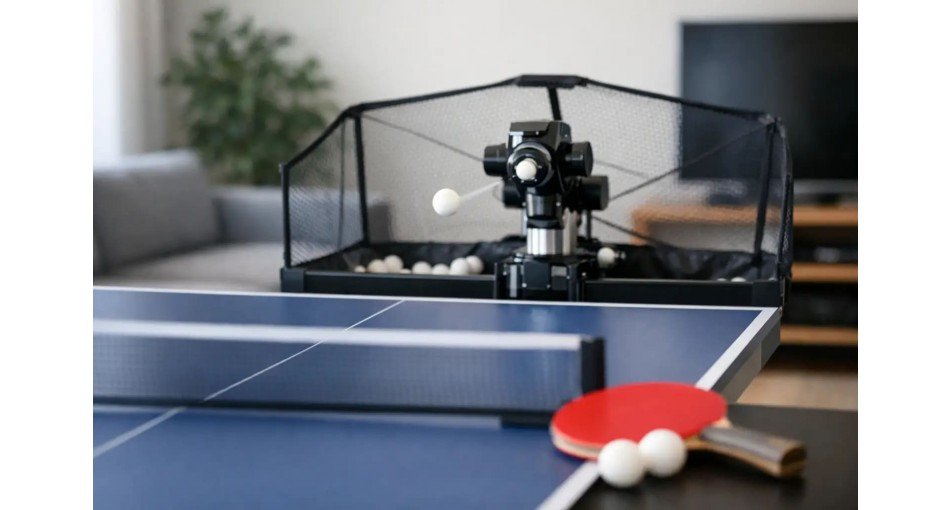
A good robot changes what home practice actually looks like. Instead of rallying in short windows when a partner is free, you can train serve receive patterns, footwork timing, backhand stability, or transition play on your own schedule. That is the real appeal of a table tennis robot for home training - not novelty, but repetition with purpose.
The catch is that not every robot helps the same type of player. Some are ideal for basic rhythm work and stroke grooving. Others are built for advanced multi-ball style drills with variable spin, speed, and placement. If you buy too low for your level, you outgrow it fast. If you buy too high without needing the features, you pay for complexity you may barely use.
For serious practice, a robot needs to do more than throw balls onto the table. It should let you repeat a specific contact point, test your timing, and expose technical flaws that are easy to hide in casual rallying.
The first thing that matters is ball quality. If the ball trajectory is inconsistent, the session becomes more about adjusting to the machine than improving your stroke. Better robots produce more repeatable arc, spin, and bounce, which makes technical work cleaner. For club players and developing juniors, that consistency is often more valuable than a long list of fancy modes.
The second factor is spin range. Topspin and backspin are the basics, but side-spin variation and no-spin options add much more value once you start training open-ups, banana flick timing, or transition balls. A robot with limited spin settings can still be useful, but it narrows the types of realistic drills you can build.
Placement control matters just as much. If a robot only feeds one location well, it is mostly a stroke repetition tool. If it can vary short-long, wide-middle, and forehand-backhand patterns with reasonable accuracy, it becomes a real footwork and decision-making tool. That is where home training starts to feel closer to structured club sessions.
A robot makes the most sense for players who already train with intent. If you know you need 15 minutes on backhand counters, then 10 minutes on forehand open-up against backspin, then a footwork sequence into recovery, you will get value quickly.
It is also a strong option for juniors with motivated parents, league players with limited club time, and coaches who want extra feeding support at home. If your weekly schedule makes regular sparring difficult, a robot can keep volume high between coached sessions.
But there are trade-offs. A robot does not read your shot, improvise, or expose you to the messy unpredictability of real points. It will not teach tactical adaptation the way match play does. For beginners, that means a robot is best used alongside basic coaching, not as a replacement for it. For advanced players, it is an excellent supplement, but not a full substitute for quality drills with another player.
If you are still building fundamentals, prioritize ease of use, repeatable feed, and simple spin adjustment. You do not need extreme frequency or dozens of preset drills on day one. You need a machine that lets you groove contact, improve consistency, and build movement without becoming frustrating to set up.
A compact robot with straightforward controls often works better here than a feature-heavy unit. The main goal is volume with clean repetition.
This is where features start to matter more. An intermediate player usually benefits from adjustable oscillation, multiple spin types, variable speed, and enough placement control to create two-point and three-point footwork drills. A decent ball capacity is also helpful, since frequent refilling breaks training rhythm.
If you play league matches, think about the situations you lose most often. Trouble against heavy backspin? Prioritize spin quality. Late to wide forehand balls? Prioritize placement and oscillation. The best robot is not always the most expensive one - it is the one that sharpens your actual weaknesses.
At the higher end, programming options, sequence memory, and realistic variation become much more valuable. Advanced users want to simulate opening patterns, counter-topspin exchanges, random placements, and tempo changes. Recovery time between shots also matters more because timing windows are tighter.
For this level, build quality is a big deal. A robot used frequently for high-intensity sessions needs reliable motors, solid feed wheels, and a collection system that does not turn every practice block into cleanup duty.
Not every premium feature deserves the extra cost. Some do.
A strong net and recycling system is one of them. In a home setup, convenience directly affects training frequency. If collecting balls takes longer than the drill itself, the robot gets used less. Good recovery design keeps sessions efficient and makes higher-volume work realistic.
Remote control is another feature that sounds optional until you use it. Being able to adjust speed, frequency, or spin without walking back to the head unit saves time and keeps focus on the session. For solo training, that is a genuine performance benefit.
Programmable drills are valuable if you will actually use them. For a player who likes structure, they are excellent. For someone who mainly wants repeatable basic feeds, manual control may be enough. This is one of the clearest it-depends decisions in the category.
Ball compatibility should not be overlooked either. Some robots perform best with quality training balls of consistent weight and roundness. If you feed them mixed, worn balls from old match boxes, accuracy can drop. That is not always the machine's fault.
The right table tennis robot for home training still needs the right space. Ceiling height, run-off room, and flooring all affect how useful the setup becomes.
If your table is pushed into a tight garage corner, wide-angle footwork drills will be limited no matter how advanced the robot is. If the floor is slippery, movement quality suffers. If lighting is poor, ball tracking becomes harder, especially with faster feeds and spin variation.
Noise is another practical factor. Some robots are quiet enough for regular home use, while others are more noticeable, especially during high-frequency sessions. If you train in an apartment or shared home, this can affect when and how often you use the machine.
One of the biggest mistakes is buying based on maximum speed alone. Fast feeds look impressive, but many players benefit more from precise medium-speed repetition than unrealistic pace. Match-relevant training usually comes from quality placement and spin, not just raw ball speed.
Another mistake is ignoring setup time. A robot that takes too long to mount, calibrate, and collect with often becomes a weekend-only tool. For home users, convenience is part of performance.
There is also a tendency to overestimate random mode. True random variation can be useful, but if your technique is unstable, too much randomness too early can make practice sloppy. Structured repetition first, controlled variation second - that usually produces better results.
A robot is only as good as the drill design behind it. If you stand in one spot blasting forehands for 30 minutes, you may feel productive without improving much.
Instead, train in blocks with a clear purpose. Use one block for timing, one for footwork, one for serve-follow-up simulation, and one for quality under fatigue. Keep the session specific. If you are working on opening against backspin, do not drift into random counterhitting just because it feels easier.
Video helps here. A robot gives you controlled repetition, which makes technical flaws easier to spot on camera. You can compare contact point, recovery position, and swing shape across dozens of nearly identical balls. That kind of feedback is hard to get in live rallying.
For players building a serious home practice environment, it also makes sense to think beyond the robot itself. Ball quality, flooring grip, shoes, and the right racket setup all shape the training outcome. Specialist stores such as TTMode.com are useful because you can match the robot decision with the rest of the performance gear around it instead of treating it as a one-off purchase.
If you are committed to improving and you have the space to use it properly, yes. The value is not just in hitting more balls. It is in hitting the right balls, more often, with a structure that supports technical change.
The best buy is the robot that matches your level, your training habits, and your available space. Get that fit right, and home sessions stop being filler work. They become a real part of your progression.