Cart
Your shopping cart is empty!
It's never too late to fix it :)

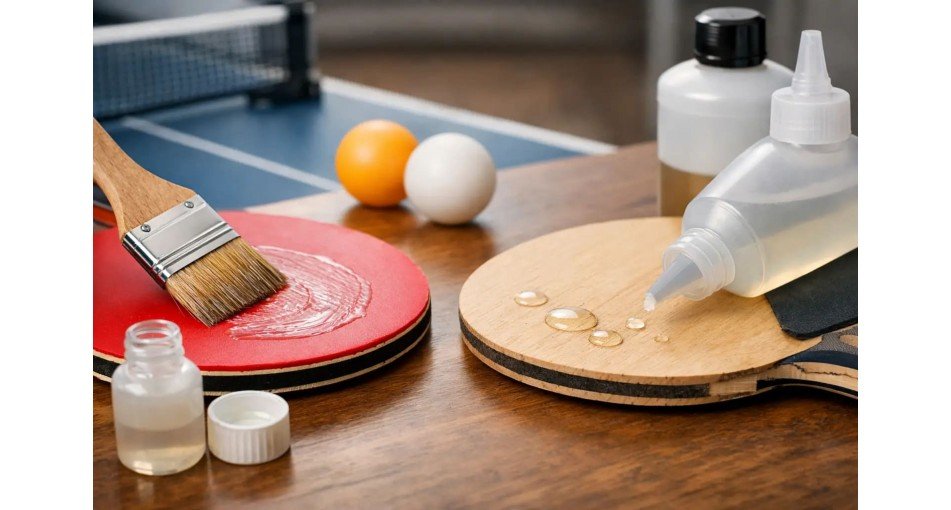
If you have ever peeled off a rubber and wondered whether you needed glue, booster, or both, you are already asking the right question. The table tennis glue vs booster debate matters because these two products do completely different jobs, and mixing them up can lead to a setup that feels dead, too bouncy, or simply wrong for your game.
For serious players, this is not a small equipment detail. The way a rubber is attached and prepared changes throw, dwell, catapult, click, and overall confidence in the short game. A fast carbon blade with a hard hybrid rubber will react very differently depending on whether you only glue it, lightly boost it, or leave it untouched.
Glue is the adhesive that fixes the rubber to the blade. Its main job is mechanical - it creates the bond between sponge and wood, keeps the sheet secure through training and matches, and allows reasonably clean removal when it is time to change rubbers.
Booster is not an adhesive. It is a tuning liquid applied to the sponge to soften it, expand it slightly, and change the playing properties of the rubber. In practical terms, boosting can add speed, increase elasticity, raise arc, and make a hard or tacky rubber feel more lively.
That is the key point: glue attaches, booster tunes.
Players sometimes expect glue to make a rubber faster in a meaningful way. Modern water-based table tennis glue can have a small effect on feel depending on how many layers you use and how evenly it dries, but it does not replace the performance change created by a booster. If your rubber feels too hard, too flat, or too linear, adding more glue is usually not the answer.
A good water-based glue gives you a clean, even bond and preserves the intended character of the rubber. For most modern ESN and Japanese-made tensors, that is all you need. These rubbers are already factory tuned, and many of them deliver their designed speed glue effect straight out of the package.
Glue still affects the setup in smaller ways. A thin, even application usually gives the most direct contact. Too much glue can make mounting messy, create uneven areas, or add a slightly softer, more muted feel. Poor application can also cause bubbles or edges lifting early, which is the last thing you want in league play.
For most players, the best glue job is the one you do not notice during a match. The rubber sits flat, the rebound is consistent, and removal later does not destroy the sponge.
Booster is used when a player wants to alter the feel and output of a rubber beyond its stock performance. This is especially common with Chinese tacky rubbers, where the top sheet grip is excellent but the sponge can feel firm and low-geared unless the player has very strong acceleration.
Apply booster correctly and the sponge domes, softens, and becomes more elastic. On the table, that often translates into easier power from mid-distance, more kick on opening loops, a higher arc over the net, and a more explosive top end. The contact can also feel fuller and less board-like.
That sounds great, but there are trade-offs. Boosting can reduce some of the crisp, dead control that certain players actually like in the short game. It can make touch shots more sensitive, and if the sponge becomes too soft for your stroke mechanics, blocks and counters may lose stability. A rubber that felt precise before can start feeling jumpy.
If you are using modern tensor rubbers from brands like XIOM, Andro, DONIC, JOOLA, Tibhar, or Butterfly, glue only is usually the smart starting point. These sheets are built to perform without extra tuning, and many already have enough catapult for aggressive topspin play.
The same goes for developing juniors, allround players, and many league competitors who want predictable response more than maximum tuning. If your focus is reliable serve receive, compact countering, and easy maintenance, a proper water-based glue setup keeps things simple and consistent.
Glue only also makes sense if you change rubbers often. Repeated boosting adds another variable to an equipment cycle that is already expensive and time-sensitive. Plenty of players would gain more from selecting the right rubber hardness than from trying to tune the wrong rubber into shape.
Boosters appeal most to players using tacky Chinese-style rubbers, especially on the forehand. Think of the classic profile: strong brush contact, explosive acceleration, and a preference for heavy spin with a powerful finishing gear. In that setup, boosting can help a hard sponge come alive.
Advanced hobbyists and equipment enthusiasts also use booster to fine-tune feel. A player may like a rubber’s grip and trajectory but want a slightly softer impact or a little more penetration from mid-distance. Booster can bridge that gap when the stock version is close, but not perfect.
Coaches and experienced players often recognize one important truth here: boosting is not magic. If your timing is late, your footwork is off, or your blade-rubber pairing is wrong, booster will not fix the underlying issue. It only changes how the rubber behaves inside the margins of your current technique.
This is where nuance matters. Water-based glue is standard and accepted for racket assembly. Booster is more complicated because competition rules and event standards can come into play, especially where racket testing is involved.
Players should always check the regulations that apply to their competitions and associations before using any tuning product. What is common in some equipment circles is not the same as what is clearly acceptable at every organized event.
There is also the maintenance side. Boosted rubbers require more patience during assembly, because the sponge expansion can create a dome that needs careful gluing and drying. If you rush the process, the sheet may not sit cleanly on the blade. Edges can lift, and cutting can become less tidy.
Booster does not replace glue. Even when a rubber is boosted, you still need glue to attach it to the blade. The normal sequence is booster on the sponge, waiting for the sponge to absorb and settle, then applying glue to both sponge and blade before mounting.
This matters because some players hear “tuned rubber” and assume the booster itself somehow acts like an adhesive or permanent treatment. It does not. You are still building a normal racket assembly - you are just mounting a sponge that has been altered first.
The number of booster layers also matters a lot. Light boosting can preserve control while adding some life. Heavy boosting can dramatically change the rubber and push it away from what made you choose it in the first place. More is not automatically better.
Start with your rubber category. If you play with a factory-tuned tensor and like its general character, use glue only first. If you play with a hard, tacky Chinese rubber and feel you are not getting enough rebound unless you swing at full effort every ball, booster may be worth considering.
Then look at your playing distance and stroke style. Close-to-table blockers and flatter hitters often prefer stability over extra catapult. Loopers who work from mid-distance or rely on heavy forehand acceleration are more likely to appreciate a tuned sponge.
Blade pairing is another big factor. A fast outer carbon blade with a springy tensor may become too lively if you chase even more bounce. On the other hand, a harder five-ply wood blade paired with a dense Chinese rubber can respond very well to mild boosting. Equipment choices interact, and the same booster treatment will not feel identical from one setup to another.
If you are buying gear with performance in mind, the smartest route is usually to solve the biggest problem first. If the issue is attachment, durability, and clean assembly, you need a quality glue. If the issue is that the rubber’s feel is too hard or too flat for your forehand game, that is where booster enters the conversation. TTMode.com stocks both categories because serious players often need different tools for different setups.
The biggest mistake is using booster to compensate for a poor rubber choice. If you need two or three rounds of tuning just to make a sheet playable for your level, there is a good chance the base rubber is not the right fit.
A better setup usually feels right early. Glue it properly, test it honestly, and only then decide whether the stock performance is missing something specific. That approach saves money, avoids endless equipment tweaking, and gives you cleaner feedback about your actual game.
If you are still stuck on table tennis glue vs booster, think of it this way: glue is essential, booster is optional, and the best decision is the one that makes your racket feel more predictable when the score reaches 9-9.