Cart
Your shopping cart is empty!
It's never too late to fix it :)

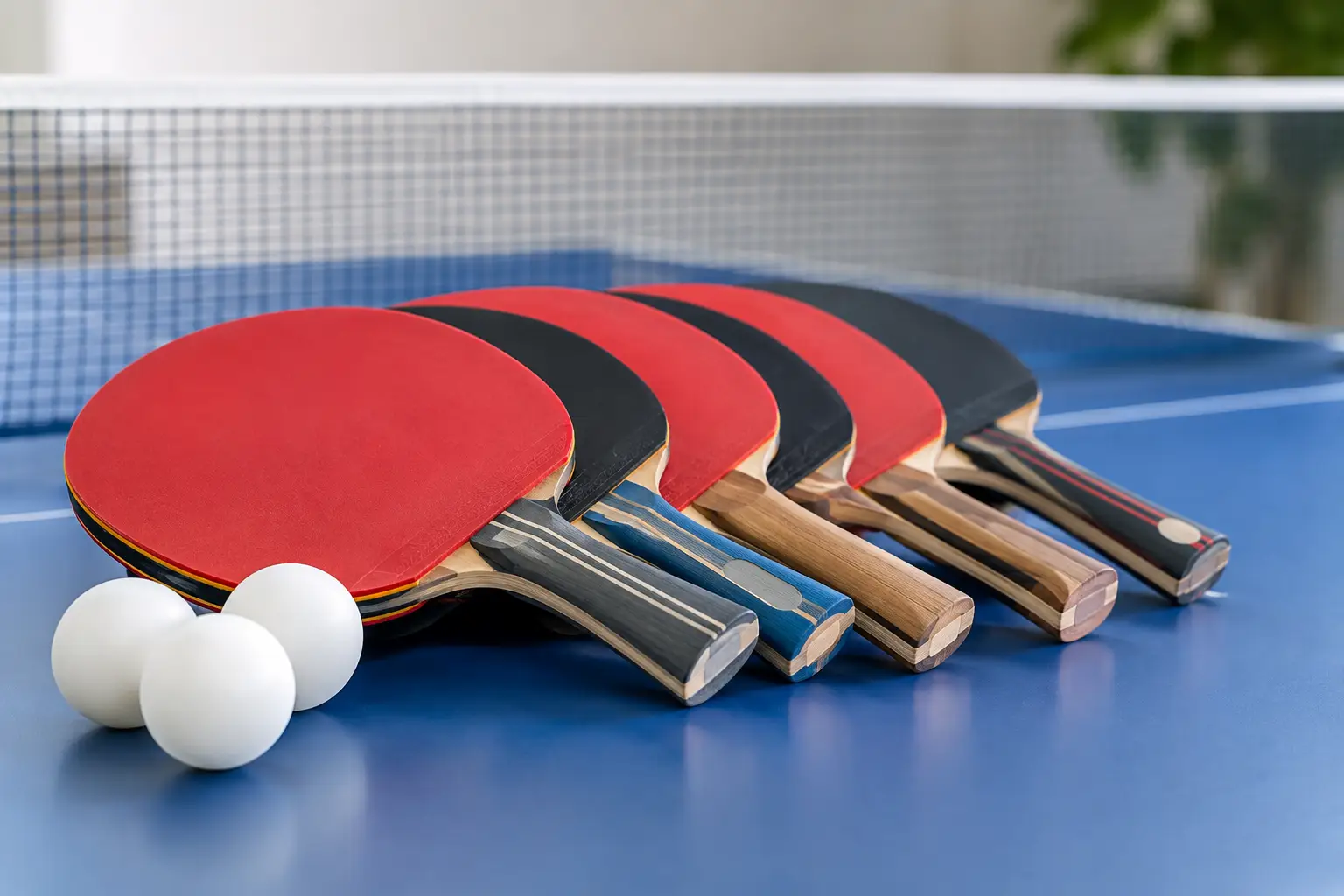
The best table tennis rackets for intermediates balance controllable power, heavy spin generation, and precise short-game feeling. Choosing a well-tuned custom blade and rubber setup allows developing players to refine their technique without sacrificing stability during fast rallies. The ideal intermediate racket rewards proper strokes while remaining forgiving on off-center contact and passive blocks.
The best table tennis rackets for intermediates are not necessarily the quickest. They are the setups that let you swing with confidence, create reliable topspin under pressure, and still control the first short push of the rally. For a developing player, that balance matters far more than a headline speed rating.
An intermediate racket should reward proper technique without punishing every slightly late contact. The five setups below cover controlled all-round play, spin-focused offense, and faster two-wing attacking styles. Each is built around respected competition equipment rather than entry-level premade paddles.
We prioritized blades around ALL+ to OFF speed, paired with rubbers that are lively but not excessively springy. Most intermediate players benefit from 2.0mm sponge on both sides: it gives meaningful power and spin while retaining a clearer feeling at impact than maximum-thickness rubber.
Our selection and testing log focused on six practical rally situations: serve receive, short push, opening loop against backspin, passive block, active counter-topspin, and mid-distance recovery. We also considered handle shape, typical blade weight, rubber hardness, and whether the setup leaves room to upgrade rather than forcing a complete equipment change six months later.
Speed labels differ between brands, so treat them as a guide rather than a universal measurement. A 5-ply OFF- wood blade can feel faster than a carbon OFF blade in the short game, while carbon often adds a larger and more stable sweet spot when the ball is struck firmly. If you are comparing pre-assembled custom options, browsing full custom Rackets can help narrow down your preferred speed and weight profile.
This is a high-performance intermediate setup for players who want carbon stability without the overly sharp rebound of a very hard, fast composite blade. The Timo Boll CAF uses cellulose acetate fiber, which produces a more controlled and wood-like impact than many traditional carbon designs. Pairing it with Rozena keeps the racket forgiving on blocks and opening loops.
The key strength is confidence at medium distance. The blade has enough support to counter topspin, but Rozena does not demand the perfect acceleration or fine brushing contact that harder professional rubbers can require. It is an excellent move for a player progressing from a basic premade racket into serious league equipment.
Assessment log: The setup is especially composed on backhand blocks and controlled counters. It does not have the raw kick of a Tenergy-equipped racket, but that is precisely why it suits intermediates who want more repeatable rallies.
The Ma Lin Extra Offensive, often called the YEO, is one of the most respected 5-ply offensive blades in modern table tennis. Its feel is direct, crisp, and more connected to the ball than most composite constructions. Rakza 7 Soft adds a grippy, high-arc response that makes it easier to open against backspin and lift a heavy push over the net.
This is the spin player’s choice. It encourages a full, technically correct stroke and provides excellent feedback on whether contact was clean. Compared with the Timo Boll CAF setup, it has a smaller sweet spot and a little less stability on rushed blocks. In return, the short game feels more precise and touch play is outstanding.
Assessment log: The ball stays on the blade long enough to make serve receive, slow spin openings, and short touch shots easier to judge. Players who hit flat through the ball more often than they loop may prefer a firmer rubber than Rakza 7 Soft on the forehand.
Not every intermediate needs an OFF racket. The Stiga Allround Classic is a classic 5-ply blade for players refining movement, placement, serve variation, and third-ball patterns. With DNA Future M in 2.0mm, it remains lively enough for modern topspin while retaining the dwell time and control that make technical improvement faster.
This is the most forgiving setup in the comparison, particularly for juniors, returning players, and all-round competitors who value a reliable backhand. It will not generate the same easy pace from mid-distance as the Xiom or Butterfly options. At the table, though, its consistency can win a surprising number of points.
Assessment log: Despite the medium-hard sponge, the blade keeps the overall response controlled. The low blade weight also helps players who struggle to recover quickly from wide forehand attacks or backhand-to-forehand transitions.
For an intermediate who is already attacking from both wings, the Xiom Stradivarius with Vega Europe is a serious offensive option. The Stradivarius uses aramid carbon to enlarge the sweet spot and provide a cleaner, more stable response on counters. Vega Europe is noticeably softer and easier to engage than many modern hard tensor rubbers, making the package accessible rather than intimidating. A useful next read on TTmode.com is Mizuno Medal Review for Serious Table Tennis.
This racket is faster and more direct than the all-wood choices here. It rewards active strokes and makes countering from mid-distance easier, but it is less tolerant of passive touches. If your serve receive is still inconsistent or you frequently pop up short balls, choose one of the slower 5-ply options first.
Assessment log: The largest gain comes on firm contact, where the composite construction resists twisting and gives a stable rebound. Its trade-off is a more immediate bounce in the short game, so disciplined soft hands are essential.
The Donic Appelgren Allplay is a smart choice for an intermediate who wants exceptional feel but does not want an underpowered racket. It is a controlled 5-ply blade with enough flex for spin production, while Baracuda supplies a very grippy topsheet and a pronounced arc. This is a setup built for players who win points through variation, placement, and heavy rotation.
Baracuda is not the fastest rubber in this group, but it grips the ball extremely well. That makes it effective for serving, slow opening loops, and changing spin on the backhand. Players seeking a direct, hard-hitting feel may find it too elastic. For a spin-oriented league player, that elasticity is a major advantage.
Assessment log: This combination has a notably high throw angle, helping opening topspin clear the net with safety. It is particularly effective for players who build rallies patiently rather than trying to finish every ball with one hard drive.
Selecting the right setup depends entirely on your stroke structure, table position, and strategic approach. Matching your blade's stiffness and rubber's hardness to your personal style creates a far more reliable setup than simply buying the fastest equipment available.
Choose the Butterfly Timo Boll CAF and Rozena setup if you want composite stability with controlled speed. Choose the Yasaka YEO and Rakza 7 Soft if ball feel, spin, and short-game quality are central to your game. The Stiga Allround Classic and DNA Future M is the strongest technical-development option, while the Xiom Stradivarius and Vega Europe suits a more established attacker.
The Donic Appelgren Allplay and Baracuda combination is the specialist pick for players who use serves, spin changes, and placement to create the next ball. It depends on how you currently score points, not simply on your rating or how long you have played.
Intermediate players can use carbon blades if they have established consistent topspin mechanics and require extra stability on active counter-drives. However, players who are still developing subtle touch in short touch play usually progress faster with 5-ply all-wood blades.
Rubber sponge hardness around 40-47.5 degrees provides the best balance for intermediate play. Medium-soft rubbers give excellent forgiveness and catapult on opening loops, while medium-hard options offer superior directional control when striking through the ball firmly.
A 2.0mm sponge is usually preferable for intermediates because it offers ample speed while preserving clear feedback from the blade. Maximum sponge thickness reduces touch on short pushes and serve receive, making passive play harder to calibrate under pressure.
A finished racket weight between 175g and 190g works best for most developing players. Rackets under 175g allow rapid wrist movement and recovery, whereas setups pushing toward 190g generate heavier dynamic ball quality at the cost of slightly slower recovery.
Your next racket should make your best technique easier to repeat, not cover up the parts of your game that need practice. Pick the setup that matches the rallies you want to play, then give it enough training time for the equipment and your stroke to work together. At TTmode.com, we help you pair the right blades and rubbers to match your personal development goals on the table.