Cart
Your shopping cart is empty!
It's never too late to fix it :)

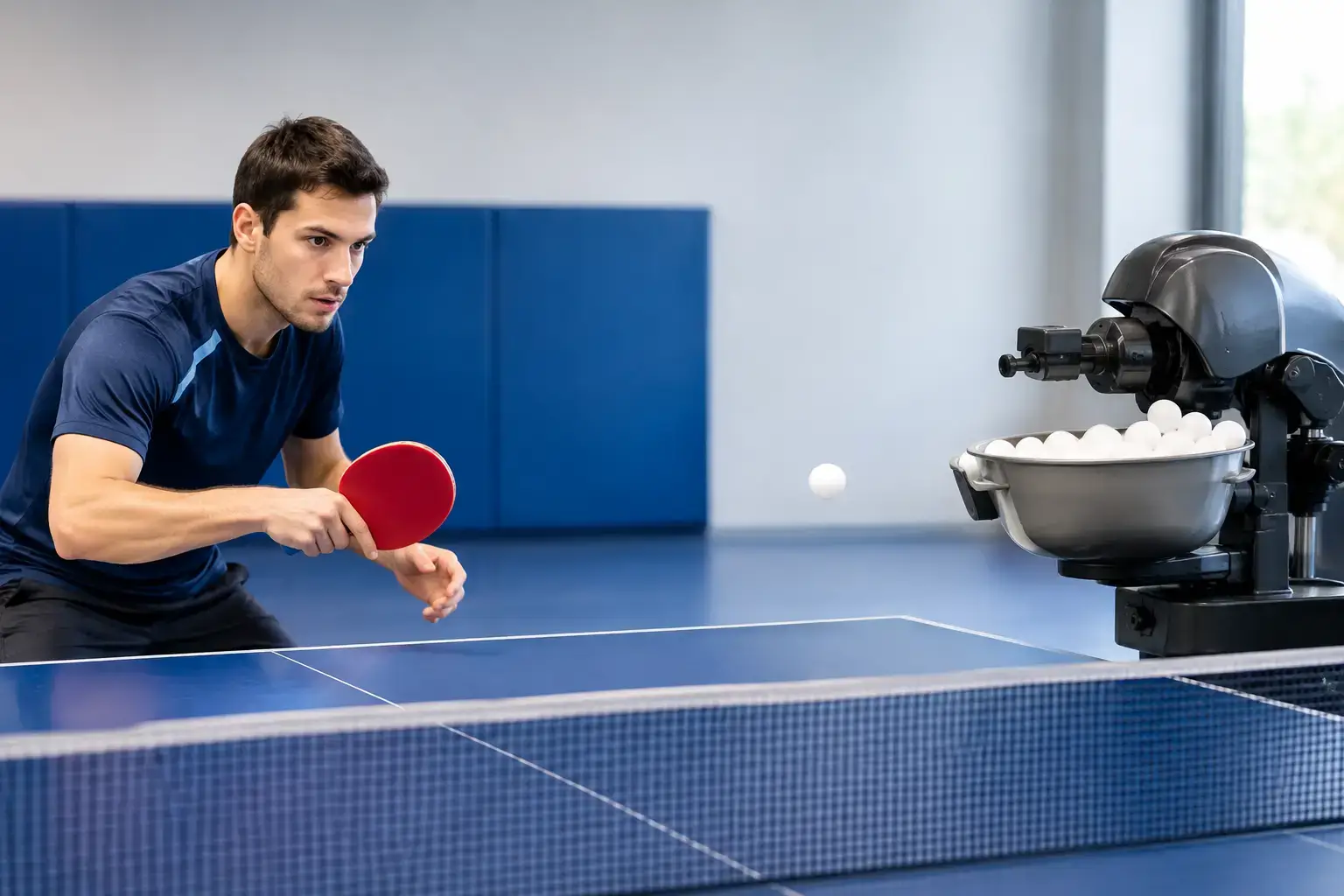
A training robot vs multiball decision is not really about which tool feeds more balls. Both can create hundreds of contacts in a short session. The real question is whether you need disciplined repetition without a partner or intelligent variation from a coach who can see the flaws in your movement, timing, and racket angle.
For a league player trying to make a backhand opening automatic, a robot can turn 30 minutes at home into 500 purposeful repetitions. For a junior learning to recover after a wide forehand, multiball can expose the exact moment their balance breaks down. They solve different training problems, and buying the wrong one often leads to a very expensive ball feeder gathering dust.
The figures above are practical ranges, not universal specifications. A two-wheel robot with oscillation and programmed drills behaves very differently from a basic fixed-head unit. Likewise, a coach feeding topspin, backspin, no-spin, and side-top balls with purposeful placement is far beyond a partner casually tossing balls from a bucket.
A robot is a high-volume practice partner that never gets tired, never serves only to your forehand, and never needs to leave after an hour. That consistency matters when the goal is motor learning. If you are rebuilding a forehand loop, you want the same incoming ball enough times to feel whether your contact point, elbow position, and weight transfer are actually repeatable.
The strongest robot sessions are specific. Program one ball deep to the backhand, one ball wide to the forehand, then recover to the neutral position. Set a realistic pace that lets you maintain quality - perhaps 35 to 55 balls per minute for developing players, or 60 to 90 for advanced footwork conditioning. Chasing maximum frequency while your technique collapses is conditioning, not quality table tennis.
A robot also works exceptionally well for return-of-serve fundamentals. Use backspin feeds to rehearse the short push, flick, or opening loop. Use fast topspin to stabilize your blocking position. For players who struggle against a particular ball, controlled exposure is often more productive than waiting for the same problem to appear in a match.
There is a limit. Even sophisticated random modes are still programmed. The ball does not read your position and exploit it. It does not disguise contact. It does not change pace because it sees you backing away from the table. A robot builds the physical and technical base, but it cannot fully create the uncertainty of an opponent.
Multiball is not simply a coach feeding balls quickly. At its best, it is a live diagnostic tool. A skilled feeder can slow the ball down when a player loses shape, raise the bounce to isolate contact height, add backspin to test lifting mechanics, then change the next ball to reveal whether the player is watching the racket rather than predicting the spin.
That immediate adjustment is why multiball is so effective for juniors and players making technical changes. If your forehand loop is too arm-dominant, 10 minutes of guided feeds with a correction after every few balls can be more valuable than 1,000 robot balls performed with the same mistake.
Multiball also develops transition skills better. A coach can feed one short backspin ball, one deep topspin to the elbow, and one wide block to the forehand. The sequence forces reading, movement, recovery, and stroke selection. It can be made predictable while learning, then progressively randomized as the player improves.
Its drawback is simple: quality depends on the feeder. Inconsistent feeding can create poor timing rather than better timing. A good multiball partner must control ball height, spin, depth, and tempo well enough to challenge the player without turning every drill into a scramble.
A training robot requires an upfront investment, plus enough room behind the table for a collection net and safe movement. It makes the most financial sense for players who can use it two or more times per week, clubs that need stations for independent practice, and families with several serious players.
Multiball requires far less equipment. A basket of 100 to 200 quality plastic balls, barriers, and a capable feeder are enough to begin. But coaching time has a real cost, and a player who only receives multiball once a week may not get enough repetitions between sessions to make a technical adjustment stick.
A practical hybrid setup is often the smartest route. Use coached multiball to identify one or two corrections. Then use a robot at moderate speed to reinforce those corrections over the next several sessions. Return to the coach before the habit drifts. TTMode shoppers building a home training area should prioritize a stable table, sufficient barriers, and ball collection before paying for advanced robot features they may not yet use.
Whether you use a robot or multiball, record the session rather than judging it by sweat alone. Start with 10 minutes of a single technical pattern at a controllable pace. Spend the next 15 minutes adding movement, such as backhand-to-forehand transitions or short-long recovery. Use 10 minutes for a serve-return pattern, then finish with 10 minutes of less predictable placement.
Track three numbers: successful balls out of 20, unforced errors caused by footwork, and whether you recovered to a ready position after each stroke. For example, 16/20 quality forehand loops means more than firing 80 balls a minute with only half landing on the table. Film one set from the side and one from behind when possible. The camera catches a late contact point and poor recovery faster than memory does.
Yes, if the beginner has basic stroke guidance from a coach, club player, or video feedback. A robot is excellent for repetition, but it can reinforce incorrect mechanics when used with no technical reference point. Start slowly and prioritize clean contact over speed.
No. Multiball develops technique, movement, and controlled reactions, but it does not replicate serves, deception, score pressure, or an opponent adapting to your patterns. Use it to prepare skills that you then test in games.
A robot is better for repeating a fixed footwork pattern hundreds of times. Multiball is better for changing the pattern, forcing recovery, and exposing whether your footwork survives an unexpected ball. Fixed first, random later is a productive progression.
A basket of 100 balls is workable for short drills, while 150 to 200 keeps a demanding session moving with fewer collection breaks. Use durable, consistent plastic training balls rather than mixed, damaged leftovers.
A robot gives you the chance to train on the days nobody else is available. Multiball gives you the informed pressure that turns a movement into a usable skill. Choose the tool that removes the biggest obstacle in your current training, then make every ball feed serve a clear match-day purpose.